Showing posts with label Diesel. Show all posts

Tuesday, 18 July 2017

Parts of a diesel generator and their functions.

We all know that a diesel generator is used as a source of backup when supply of power is not constant. They have assumed great importance and have almost become a necessity for households and companies in areas where there is a shortage of electrical supply. Given the promising nature of a diesel generator, we all have at some point used it or at least have known its merits. But have we ever tried to understand what are the various parts that power the diesel generator and help it function?

Let us look at some of the main components of a diesel generator and their functions:
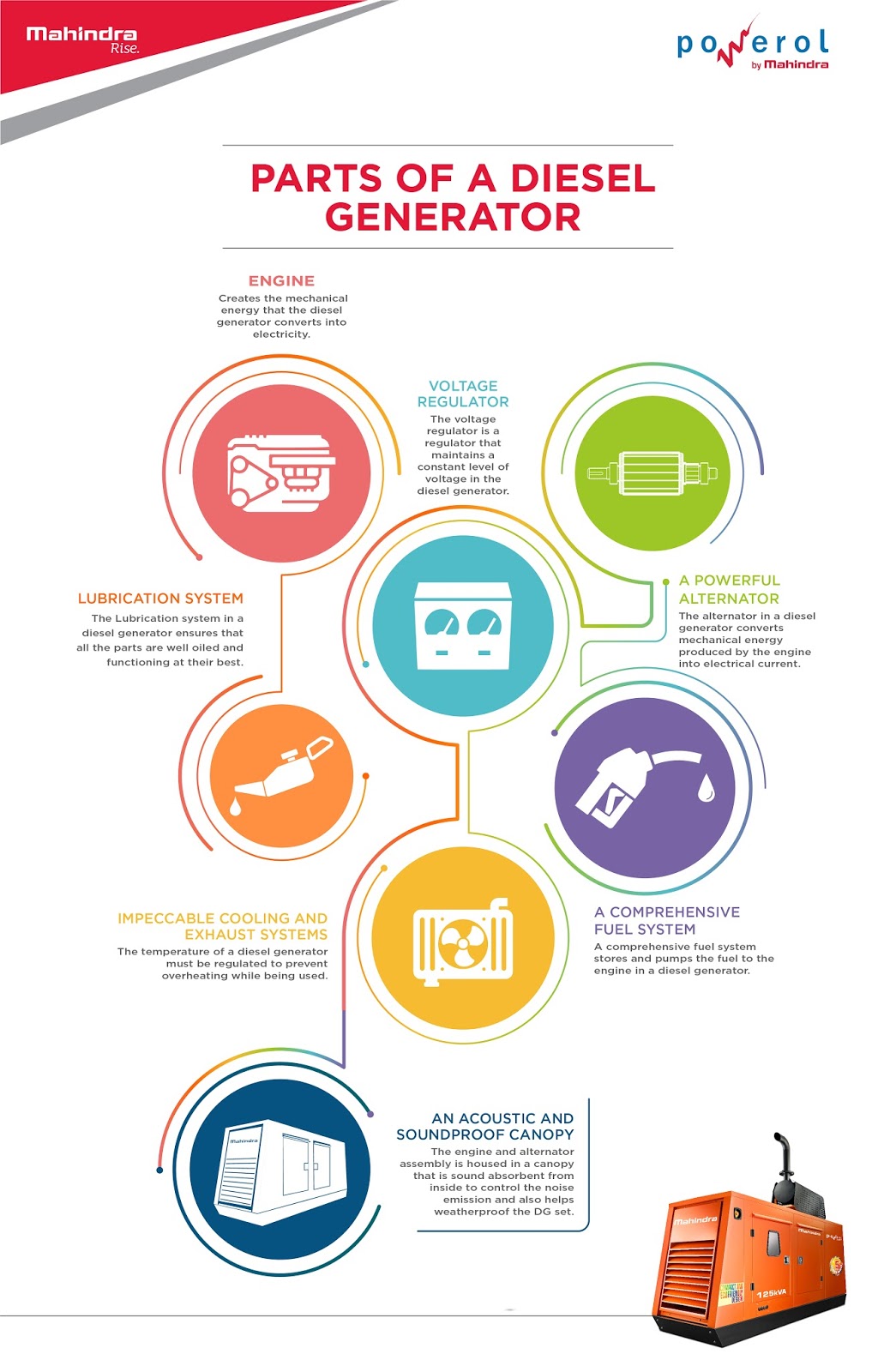
1.       Engine – The heart of the system
The function of the engine is to create the mechanical energy that the diesel generator converts into electricity. The design of the engine is aimed at generating a maximum supply of electrical current by running on diesel or other alternate fuels.

2.       A comprehensive fuel system
Generators that run on diesel or any other fuel, have a fuel system that stores and pumps it to the engine. The tank stores a good amount of fuel to power the generator for several hours at a stretch. A fuel pipe in the system connects the tank to the engine while a return pipe connects the engine to the fuel tank for the return of fuel. A fuel pump moves fuel from the tank through fuel pipe and to the engine. There is a fuel filter which filters out debris from the fuel, if any before delivering it to the engine. A fuel injector atomizes and injects the fuel directly into the combustion chamber of the engine.

The alternator in a diesel generator converts mechanical energy produced by the engine into electrical current. It comprises of the stator and the rotor (or armature). The stator is stationary and contains a set of coils that conduct electricity. The rotor moves to create a constantly rotating electromagnetic field around the stator.
4.       Voltage Regulator
The alternator may generate electrical voltage but the level of voltage needs to be regulated that is suitable for practical use. Voltage regulator is an electrical regulator that maintains a constant level of voltage.

5.       Impeccable cooling and exhaust systems
The temperature of a diesel generator must be regulated to prevent overheating while being used. Generators can use a fan, coolant or both to control the temperature of the generator at work. The internal combustion engines are usually cooled by passing engine coolant through the engine block. The generator also produces exhaust as the combustion chamber converts fuel. There are exhaust systems that dispel harmful gases emitted.

6.       Lubrication system
A diesel generator comprises of various moving parts. These parts need to be oiled for their smooth functioning. The lubrication system ensures that the parts are well oiled and functioning at their best.

7.       Acoustic Enclosure
Being a mechanical product with many moving parts, a diesel engine makes lot of noise during its operation. In order to control the noise emission, the engine and alternator assembly is housed in a soundproof canopy having sound absorbent material from inside. As per Central Pollution Control Board (CPCB), the maximum noise emission from a generator should not exceed 75 dBA from 1 m distance from the canopy.

For more information about diesel generators, please visit: http://www.mahindrapowerol.com/  or
call us at Toll Free: - 1-800-419-1999


Tuesday, 19 August 2014

Mahindra Powerol celebrates Mahindra Sustainability Month by planting 50,000 saplings across India and Overseas

Esops leader Mr. Palaniappan planting 
sapling in Bangalore

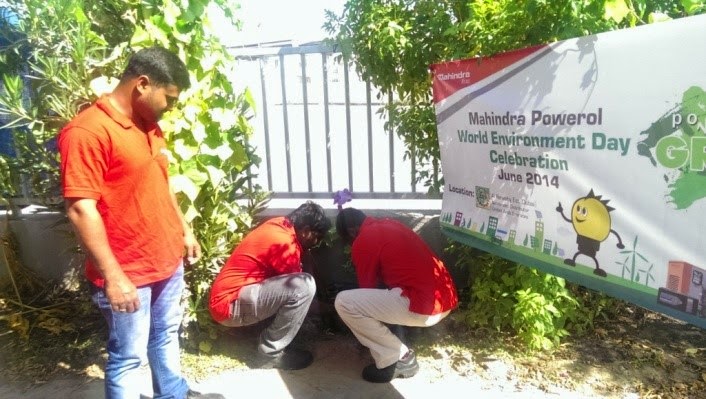
June ‘14: In support of Mahindra’s Sustainability Month and World Environment Day, Mahindra Powerol launched its Sustainability Initiative ‘Powerol Green Team’. ‘Powerol Green Team’ is a group of Powerol employees who have pledged to raise their voice against climate change and participate in the various sustainability driven activities conducted in Powerol, the chief being the Mega Plantation Drive across India and Overseas. Over 200 Powerol employees across India are part of the Mega Plantation Drive was conducted on 14th June 2014.

Esops Champion Mr. Goyal
Mahindra Powerol geared up for this ambitious plan of planting 50,000 saplings across India and in two international locations – UAE and Nepal.
Mr. Palaniappan, Esops Leader, Sr. Vice President and Business Head – Powerol initiated the drive by planting the first sapling in Bangalore.
The Esops champion Mr. Narendra Goyal, General Manager – Powerol Business, led the drive with relentless passion along with the Esops Implementation Committee.

Powerol Green Team from Kandivali participated in Plantation Drive on 14th June’14

Plantation drive in Dubai
Mahindra Powerol invited its channel partners to actively participate in mega plantation initiative. The response was overwhelming and helped Powerol achieve its target of planting 50,000 saplings!
Special thanks to the local coordinators of each location who ensured this drive was successful.  


Celebrating Sustainability Month and World Environment Day is about the inspirational power of a few individual actions that collectively become an exponential force for driving positive change. Powerol will be organizing more activities as part of its CSR initiatives. 

Tuesday, 12 November 2013

LIGHT-EMITTING DIODE AND ITS IMPORTANCE

A light-emitting diode (LED) is a semiconductor of light source. LEDs are used as indicator lamps in many devices and are increasingly used for general lighting. Basically, LEDs are just tiny light bulbs that fit easily into an electrical circuit. But unlike ordinary incandescent bulbs, they don't have a filament that will burn out, and they don't get especially hot. They are illuminated solely by the movement of electrons in a semiconductor material, and they last just as long as a standard transistor. 

The lifespan of an LED surpasses the short life of an incandescent bulb by thousands of hours. Studies reveal that LED bulbs produce less carbon than older bulbs, which can be very useful to get rid of the ill effects of global warming.

These energy saving bulbs have a very long life, and they are able to remain consistent despite of long-term use. In other words, they are not easily hampered, even if you are using them for long hours. So, one can buy the bulbs according to their preference, those which do not need to be swapped frequently.


Light-emitting diodes are used in applications as diverse as aviation lighting, automotive lighting, advertising, general lighting, and traffic signals. LEDs have allowed new text, video displays, and sensors to be developed, while their high switching rates are also useful in advanced communications technology. LED grow lights have been one of the best innovations in farming as it helps improve the different aspects of gardening. There are interesting applications also which uses LED bulbs such as UV-LEDs for the sterilization of water and disinfection of devices and to enhance the photosynthesis in plants as a grow light. 

Monday, 14 October 2013

DAYLIGHT SAVING TIME

Daylight saving time —also summer time in British English— is the practice of advancing clocks during the lighter months so that evenings have more daylight and mornings have less. Typically clocks are adjusted forward one hour near the start of spring and are adjusted backward in autumn.
The modern idea of daylight saving was first proposed in 1895 by George Vernon Hudson and it was first implemented by Germany and Austria-Hungary starting on 30 April 1916. Many countries have used it at various times since then. Much of the United States used DST in the 1950s and 1960s, and DST use expanded following the 1970s energy crisis. It has been widely used in North America and Europe since then.
The rationale behind the 1975 study of DST-related energy savings was that energy use and the demand for electricity for lighting homes is directly related to the times when people go to bed at night and rise in the morning. In the average home, 25 percent of electricity was used for lighting and small appliances, such as TVs and stereos. A good percentage of energy consumed by lighting and appliances occurred in the evening when families were home. By moving the clock ahead one hour, the amount of electricity consumed each day decreased.
In the summer, people who rose before the sun rises used more energy in the morning than if DST were not in effect. In the winter, the afternoon Daylight Saving Time advantage is offset for many people and businesses by the morning's need for more lighting. In spring and fall, the advantage is generally less than one hour. So, the rationale was that Daylight Saving Time saves energy for lighting in all seasons of the year, but it saves least during the four darkest months of winter (November, December, January, and February), when the afternoon advantage is offset by the need for lighting because of late sunrise.

In addition, less electricity was thought to be used because people are home fewer hours during the "longer" days of spring and summer. Most people plan outdoor activities in the extra daylight hours. When people are not at home, they don't turn on the appliances and lights. 

Monday, 7 October 2013

Inception and Evolution of Electricity in India.

HISTORY AND EVOLUTION OF ELECTRICITY


Electricity, as we know it, is largely a product of eighteenth and nineteenth century scientific and engineering developments. At the very inception in our country the consumption of electricity was started for lightening the palaces of the King of Coochbehar in West Bengal and the King of Bikaner in Rajasthan


In December, 1896 Indian Electric Company, which was registered in London in 1895, was favored with the license to distribute and sell electricity in 5.6 Square Mile area in the city of Calcutta, the then capital of India, under Calcutta Electricity Lighting Act for 21 years. Kilbern & Co. was engaged as agent of the said Indian Electricity Company with effect from the 7th January, 1897. The private entrepreneurships solely were engaged in generation, distribution, and sale and in development of electricity in our country up to the year 1948 prior to enactment of the Indian Electricity Act 1948. The number of electrified villages and pumps engaged in agriculture were 1500 and 6500 respectively. Per capita consumption of electricity in India was only 16 units at that time. 

CHANGE IN POWER SECTOR POST INDEPENDENCE:


The power sector in India has undergone significant progress after Independence. When India became independent in 1947, the country had a power generating capacity of 1,362 MW.
Hydro power and coal based thermal power have been the main sources of generating electricity. Generation and distribution of electrical power was carried out primarily by private utility companies.

Notable amongst them and still in existence is Calcutta Electric. Power was available only in a few urban centers; rural areas and villages did not have electricity.

After 1947, all new power generation, transmission and distribution in the rural sector and the urban centers (which were not served by private utilities) came under the purview of State and Central government agencies. State Electricity Boards (SEBs) were formed in all the states. Nuclear power development was introduced, in late sixties. The concept of operating power systems on a regional basis crossing the political boundaries of states was introduced in the early sixties. 

Monday, 23 September 2013

GENERATORS- AN OVERVIEW

The generator evolved from the work done by Michael Faraday along with Law Joseph Henry, who in the 1820s discovered the operating principal of electromagnetic generators. This principle is now called Faraday's. Once these two inventors discovered and documented the phenomena of electromagnetic induction, it lead to experimentation by others in both Europe and North America.
Diesel powered generators, or electrical generator sets, are used in countless industrial and commercial establishments. These generators can be used for small loads, such as in homes, as well as for larger loads like industrial plants, hospitals, and commercial buildings. They can either be prime power sources or standby/back-up power sources. They are available in various specifications and sizes. Diesel generator sets rating 5-30KW are typically used in simple home and personal applications like recreational vehicles. Industrial applications cover a wider spectrum of power ratings (from 30 kW to 6 Megawatts) and are used in numerous industries throughout the world. For home use, single-phase power generators are sufficient. Three-phase power generators are primarily used for industrial purposes.

There are two types of generators: permanent and standby. The permanent ones run on an existing fuel source – either liquid propane or natural gas and are capable of generating enough wattage. The portable generators are smaller and can be wheeled around. Their primary source of fuel is gasoline. Generators are reasonably safe as long as the safety precautions are met and no misuse takes place. Generators are best used outdoors where it is well ventilated as the carbon monoxide that a generator releases can prove fatal if inhaled over a period of time. Generators have a low voltage system along with economic benefits and low operating costs and maintenance costs. The systems are extremely compact with a simple design. 

Tuesday, 27 August 2013

Blow-by gases

Is your diesel generator leaking fumes? Not to worry, a small percentage of gas will escape during normal operations?
Learn about ‘Blow- by’ gases...

Blow-by gases are present with all internal combustion engines.

A healthy engine will normally have a Blow-by of 1% of its swept volume (flow in LPM – Litre per minute).

Blow-by is the gas that enters to engine’s crankcase during Power Stroke and  Compression Stroke. This gas is composed of unburnt fuel,  air and combustion by-products.
 
BLOW-BY FLOW PATHS
Blow-by happens because perfect sealing between the Cylinder wall (Cylinder Bore) and Piston is not possible. The tangential load pressing the Piston Rings into the bore wall create a good seal, but still there are gaps, and gases get through them and enters the Crankcase. Refer the figures to see the gaps.

The Blow-by gases enters the crankcase, if they are left unchecked it will eventually build up pressure and can cause the oil to be blown past the crankshaft and camshaft seals !!

Some engine design have a Open Breathing System where the Blow-by gases are breathed out to atmosphere and some design have a Closed Breathing System where the Blow-by gases re-enter into the air intake system.

If engine is put under full load during starting (when the piston temperature is yet to reach its operating temperature) it will cause accelerated wear and tear of the Cylinder Bore. Worn out cylinder leads to increased blow-by and loss of power. It is always advisable to give sufficient time to warm-up before the engine is put under load.

Wednesday, 17 July 2013

Benefits of Diesel Generators.


People have been using generators for ages as they serve as the perfect backup solution in case of power failure. These generators are used for a wide range of applications including telecom sites, hospitals, residential complexes, offices etc.

Generators may run on petrol, diesel, gas (CNG, LPG) or bio-diesel, but diesel generators are still the most preferred choice for off grid power solution in almost all commercial as well as domestic applications today.

To arrest the noise of diesel engines a sound attenuated enclosure, also known as Canopy, is used. Generator with Canopy is also known as silent generator.

Diesel Generators benefit greatly primarily from the source of its fuel i.e. Diesel


·         Diesel is the most abundantly found fuel among all other fuels. Therefore it is the more suited option for factories located in remote areas.

·         Diesel contains more energy than petrol, that is why diesel engines are more fuel efficient than petrol engines. It consumes less fuel and delivers superior performance.

·    Diesel is relatively less expensive as compared to other liquid fuels available in the market and hence is commercially more viable for industries.

·         Diesel fuel is safer than petrol or gas as it is less flammable.

Apart from these diesel generators have several other advantages:
·         Diesel generators can operate perfectly in extreme cold climates with the use of Glow Plugs.

·         Diesel engines are simple in design and built ruggedly. Due to their robust built, diesel engines are extremely stable and can withstand heavy load.  They can be resold at a high market price even after 5 years.

·         Diesel Generators can remain operational for long periods of time and have very low probability of breakdown. To ensure a long-lasting function, the generator should be installed in a proper manner and basic maintenance plan should be adhered to. Diesel engines generally run 10000 hours before it needs any service beyond basic maintenance.

·         Basic maintenance of a diesel engine is less expensive and simple, like changing Oil, Fuel, Air filters and periodic change of Oil and Coolant. On the other hand with Petrol or Gas engine one has to deal with tune ups, carburettor adjustments, distributor burns, spark plugs which requires periodic cleaning and replacement.

·         The glow plugs used in diesel engines have better running life than spark plugs.

·         A diesel engine consumes less lubricating oil compared to other engines, thus saves money.

For any further questions, please visit our YouTube page to explain proper installation and commission of the diesel generator. www.youtube.com/mahindrapowerol

This post is brought to you by Mahindra Powerol, leading manufacturers of diesel generators, industrial engines and home ups inverters and batteries. www.mahindrapowerol.com/ www.mahindrapowerolhups.com