
Showing posts with label electricity problems. Show all posts

Friday, 27 September 2019

SMART CONSUMER - Understanding The Earth, Neutral and Phase Points

When you call an electrician what does he check? How does he identify faults in your electricity supply lines? Do you have clear understanding of the Phase, Neutral and Earth points in the sockets of your house?


Well, we are not trying to teach you Electrical Engineering. As a consumer, it is smart to be aware of the electricity distribution from Power Plant to your house. It is also important to understand the Phase – Neutral – Earth points and what is their importance. 


Let us first understand the basic of domestic electricity supply chain.

Domestic electricity supply can be broadly divided into three categories:


       1. Generation
       2. Transmission
       3. Distribution


GENERATION: Generation happens in big power plants (Thermal, Hydro, Nuclear, Solar, Wind etc)


TRANSMISSION: Generated power is stepped up for ease of transmission. Power is transmitted via DELTA connection, (a Delta connections needs only 3 wires R-Y-B).


DISTRIBUTION: From the transmission lines the power is stepped down through local transformers and from the local transformer connection is distributed to individual houses. 


From the local transformers power is distributed to different houses as STAR connection which is having 4 wires. Three Phase wires and one Neutral wire. The Neutral point in the transformer is connected to the ground.


For domestic connections, the Neutral point is common, and any one phase (R, Y or B) is given as line to individual houses.


Understanding the Socket

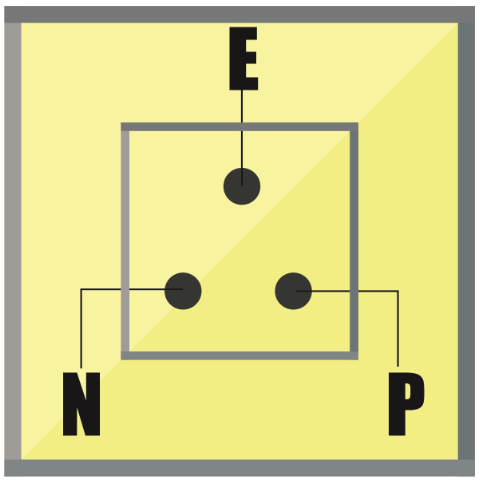
According to electricity rules, the left point will be Neutral (N) and the right point will be Phase (P). The Earthing (E) point will be at the top. The earthing is used for safety purpose.

Point P should always have power, this can be checked by a Tester. The N point has no power in it, it cannot be checked with a Tester. To check the N point, a test lamp should be used.


What is the difference between Earth and Neutral?

Neutral is connected to the Neutral point of your local distribution transformer.
The Earth point is unique, made for your house only.


Why Earthing is important?

If earthing is not done, there will be chances of electrical shock in case there is some fault in the circuit.


No risk of electric shock if Earthing is done even if there is a fault in the circuit.


Mahindra Powerol deals in robust and fuel-efficient diesel and gas gensets ranging from 5kVA to 625 kVA. To know more about our products visit us at www.mahindrapowerol.com  or call us at 1800-419-1999

Monday, 14 October 2013

DAYLIGHT SAVING TIME

Daylight saving time —also summer time in British English— is the practice of advancing clocks during the lighter months so that evenings have more daylight and mornings have less. Typically clocks are adjusted forward one hour near the start of spring and are adjusted backward in autumn.
The modern idea of daylight saving was first proposed in 1895 by George Vernon Hudson and it was first implemented by Germany and Austria-Hungary starting on 30 April 1916. Many countries have used it at various times since then. Much of the United States used DST in the 1950s and 1960s, and DST use expanded following the 1970s energy crisis. It has been widely used in North America and Europe since then.
The rationale behind the 1975 study of DST-related energy savings was that energy use and the demand for electricity for lighting homes is directly related to the times when people go to bed at night and rise in the morning. In the average home, 25 percent of electricity was used for lighting and small appliances, such as TVs and stereos. A good percentage of energy consumed by lighting and appliances occurred in the evening when families were home. By moving the clock ahead one hour, the amount of electricity consumed each day decreased.
In the summer, people who rose before the sun rises used more energy in the morning than if DST were not in effect. In the winter, the afternoon Daylight Saving Time advantage is offset for many people and businesses by the morning's need for more lighting. In spring and fall, the advantage is generally less than one hour. So, the rationale was that Daylight Saving Time saves energy for lighting in all seasons of the year, but it saves least during the four darkest months of winter (November, December, January, and February), when the afternoon advantage is offset by the need for lighting because of late sunrise.

In addition, less electricity was thought to be used because people are home fewer hours during the "longer" days of spring and summer. Most people plan outdoor activities in the extra daylight hours. When people are not at home, they don't turn on the appliances and lights. 

Tuesday, 23 July 2013

Indian Power Scenario 2013

Electric energy occupies the top grade in energy hierarchy. It finds innumerable uses in home, industry, agriculture and even in transport. The fact that electricity can be transported practically instantaneously, almost pollution-free, at the consumer level and that its use can be controlled very easily, makes it very attractive as compared to other form of energy.
The per capita consumption of electricity in any country is; index of the standard of living of the people in that country. As per the latest figures, the annual per capita consumption of electrical energy in some of the countries is: USA—11,920 kWh, Canada— 16,020 kWh Japan—6,750 kWh, UK- 5,467 kWh, Russia-6,017 kWh and India – 498 kWh in 2012.


The electric energy demand in India during the past 20 years was higher than the gross generation as a result 
of which there were massive power-cuts. Monsoons are another reason for the increase in these power cuts. The load-shedding has been in force for the last several months as the water level in reservoirs depleted drastically due to deficient rainfall last year. There are several issues that characterize India's energy scenario today. These can be briefly listed as follows:
The present installed capacity in our country is about 225.133 GW as on May 2013 and the largest share in power generation is contributed by thermal power plants, which account for about 78.7 percent of the total power generated in country. Hydel power contributes about 18.5 percent while nuclear power accounts for only 2.7 percent. The rest being accounted for by diesel, wind, solar and gas plants.

In December 2011, over 300 million Indian citizens had no access to electricity. Over one third of India's rural population lacked electricity, as did 6% of the urban population. Of those who did have access to electricity in India, the supply was intermittent and unreliable. In 2010, blackouts and power shedding interrupted irrigation and manufacturing across the country.
The problem of rising power cuts can be resolved by adopting the following technologies which have been invented for the same purpose:

One type of technology includes inducting micro-turbines using natural gas that could enable individual households and shops to generate their own power cheaply, keeping grid as a backup.


Another such technology would be the construction of a Km long tower with saline or brackish water being poured from top so that as it hurtles down, the water reaches velocity of 70 km/h, good enough to drive turbines and generate electricity. Apart of this electricity would be used to pump water up and the remaining be utilized for consumption. Another device that could be used is a UPS (also called an inverter); a power storage device is a silent solution to power cut problems.