
Showing posts with label candles. Show all posts

Tuesday, 18 July 2017

Parts of a diesel generator and their functions.

We all know that a diesel generator is used as a source of backup when supply of power is not constant. They have assumed great importance and have almost become a necessity for households and companies in areas where there is a shortage of electrical supply. Given the promising nature of a diesel generator, we all have at some point used it or at least have known its merits. But have we ever tried to understand what are the various parts that power the diesel generator and help it function?

Let us look at some of the main components of a diesel generator and their functions:
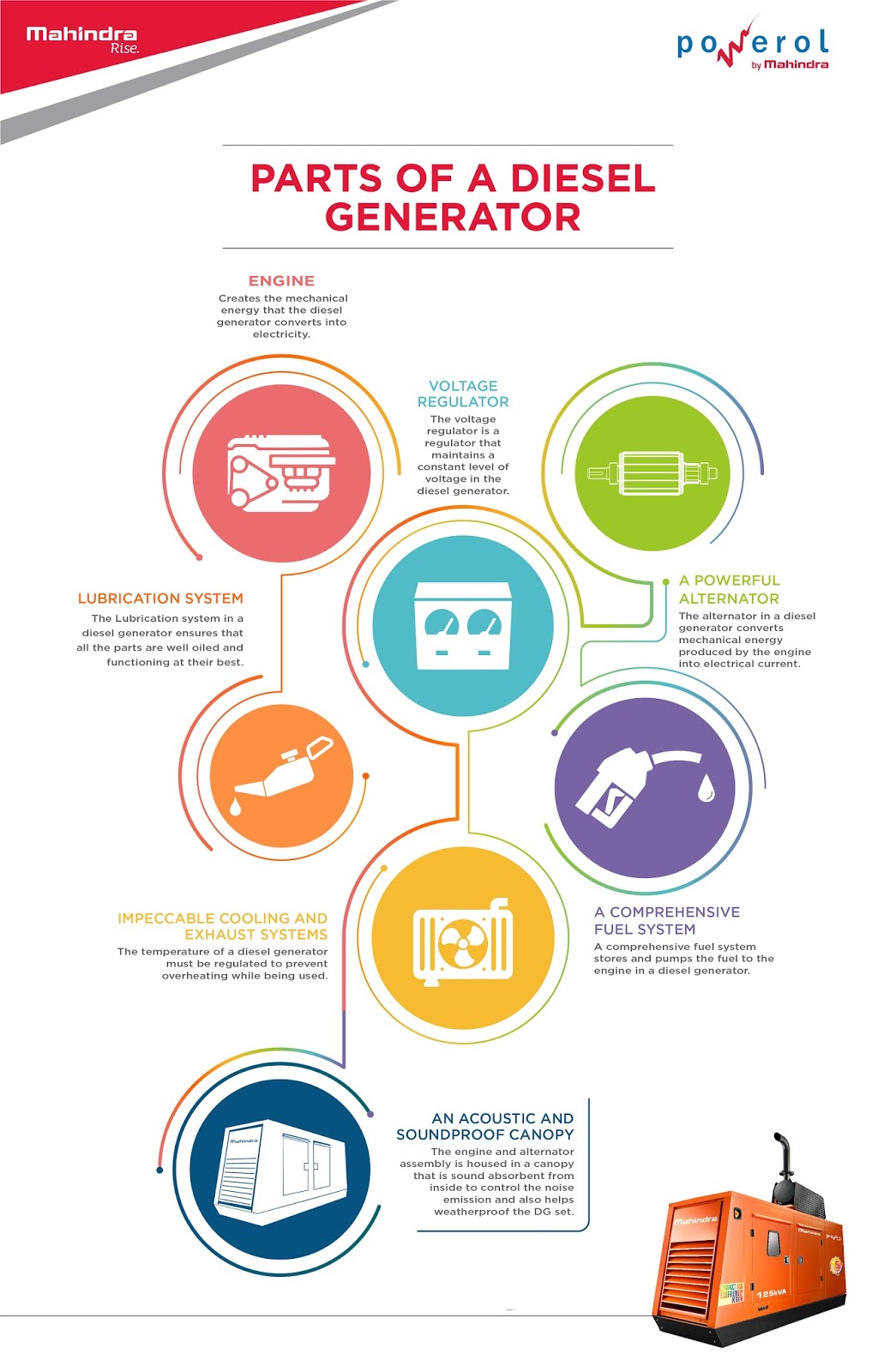
1.       Engine – The heart of the system
The function of the engine is to create the mechanical energy that the diesel generator converts into electricity. The design of the engine is aimed at generating a maximum supply of electrical current by running on diesel or other alternate fuels.

2.       A comprehensive fuel system
Generators that run on diesel or any other fuel, have a fuel system that stores and pumps it to the engine. The tank stores a good amount of fuel to power the generator for several hours at a stretch. A fuel pipe in the system connects the tank to the engine while a return pipe connects the engine to the fuel tank for the return of fuel. A fuel pump moves fuel from the tank through fuel pipe and to the engine. There is a fuel filter which filters out debris from the fuel, if any before delivering it to the engine. A fuel injector atomizes and injects the fuel directly into the combustion chamber of the engine.

The alternator in a diesel generator converts mechanical energy produced by the engine into electrical current. It comprises of the stator and the rotor (or armature). The stator is stationary and contains a set of coils that conduct electricity. The rotor moves to create a constantly rotating electromagnetic field around the stator.
4.       Voltage Regulator
The alternator may generate electrical voltage but the level of voltage needs to be regulated that is suitable for practical use. Voltage regulator is an electrical regulator that maintains a constant level of voltage.

5.       Impeccable cooling and exhaust systems
The temperature of a diesel generator must be regulated to prevent overheating while being used. Generators can use a fan, coolant or both to control the temperature of the generator at work. The internal combustion engines are usually cooled by passing engine coolant through the engine block. The generator also produces exhaust as the combustion chamber converts fuel. There are exhaust systems that dispel harmful gases emitted.

6.       Lubrication system
A diesel generator comprises of various moving parts. These parts need to be oiled for their smooth functioning. The lubrication system ensures that the parts are well oiled and functioning at their best.

7.       Acoustic Enclosure
Being a mechanical product with many moving parts, a diesel engine makes lot of noise during its operation. In order to control the noise emission, the engine and alternator assembly is housed in a soundproof canopy having sound absorbent material from inside. As per Central Pollution Control Board (CPCB), the maximum noise emission from a generator should not exceed 75 dBA from 1 m distance from the canopy.

For more information about diesel generators, please visit: http://www.mahindrapowerol.com/  or
call us at Toll Free: - 1-800-419-1999


Thursday, 13 December 2012

The Lights of Life


“No one lights a lamp in order to hide it behind the door; the purpose of light is to create more light, to open people's eyes, to reveal the marvels around.” ― Paulo Coelho
A metaphor to the victory of ‘good’ over evil, the power of lights is undeniable. From the light of the sun to mark the beginning of a new day, to our inner radiance which guides us; lights are an integral part of our existence. Celebrating the spirit of liberation, here’s a peek into some of the popular festivals across the world where lights carry significance.
St. Lucia’s Day –
Sweden, Italy, Croatia, Scandinavia, and France celebrate St. Lucia’s Day on December 13 every year. Marking the beginning of Christmas, this festival begins before dawn wherein the eldest daughter in each household leads her siblings into songs. They hold candles and sing about the light and joys of Christmas. Their songs are meant to awaken their parents and the entire family who then has breakfast together. It is a way of welcoming the season of Christmas with lights and warmth.
Lunar New Year –
Different cultures have different interpretations of how to celebrate a festival of Lights. The Lunar New Year or the Chinese New Year is another festival of lights. Every year, at the first new moon in Aquarius, people living in Vietnam, Malaysia, Indonesia and China celebrate their new year with fireworks, lanterns and gifts.
Hanukkah –
Popularized over the decades and most recently in the reruns of the popular sitcom ‘Friends’, the Jewish festival of Hanukkah goes on for eight days. Candles are lit every day and children receive new gifts on each of these eight days. The lighting of candles also symbolises knowledge and wisdom.
Christmas –
Christmas is one of the most famous festivals celebrated all over the world. Lights, star shaped lanterns, gifts, Santa Claus, candles – it is a festival of joy. Different countries celebrate Christmas differently though.
In Egypt, it is celebrated on January 6 and 7. Churches there are decorated with special lamps and people indulge in prayers, feasts and happiness.

In Philippines, 'parols' or star lanterns are displayed from nine days before Christmas. People decorate their homes with varying sizes of parols.
In China, people put up paper lanterns in their homes. They also decorate Christmas trees with paper chains, flowers and lanterns.
In Mexico, families go around from house to house with candles looking for a room in an inn. They start this tradition nine days prior to the day of Christmas in an attempt to replicate or enact Joseph and Mary’s search in Jerusalem. The procession is called Posada.
In Australia, houses are decorated in advance. Greeting cards are sent out, carols are sung and candles are lit.
Undoubtedly, the American Christmas has become the most popular. Lights, candles, carols, fireworks and feasts – Christmas in America is incomplete without all these things.
New Year – Brazil
Brazilians celebrate December 31 in their own special way. On the eve of the New Year, people in Rio de Janeiro go to the beach at midnight to offer their prayers to Lemanja, the African goddess of water. Hundreds of candles are lit on the sand and white flowers are offered to the sea as a gift to the goddess.
Kwanzaa, in the United States, is a week-long celebration to honour African harvest traditions. It is observed from December 26 to January 1 every year. Seven candles are lit each night for all seven days of the festival. The candles represent the seven principles of Kwanzaa which are unity, self-determination, collective work and responsibility, cooperative economics, purpose, creativity, and faith.
Diwali –
Last but not the least; we have our very own festival of lights, Diwali or Deepavali is one of the most popular and the most awaited festivals in India. Diwali marks the home coming of ‘Lord Ram’ after his 14 year exile and is a symbol of hope and all that is good. This festival brings people together as it dispels darkness around. Deepavali actually means row of lamps in Sanskrit and the sight of tiny clay lamps or diyas lined up in all homes and shops is a picturesque sight. These diyas are illuminated throughout the night as part of Hindu tradition. Although now fast being replaced by colourful electric bulbs, the sheer brightness only adds fervour to the festive season.

Festival times may differ. Continents may be far. It is this visual language of light that binds us as one.