Thursday, 27 February 2020

ePowerol: The Intelligent Digital Platform for Customers


Digitization has invaded our daily lives like never before. Be it grocery shopping, ticket booking, banking, booking doctor’s appointment the list is endless. Almost every task of our daily lives is aided by digital technology. Customers are managing their tasks online. They expect the same flexibility from every company they interact with.

Powerol has always been a front runner when it is about adopting new technologies and innovation. You may follow our blog Powerol & Technology.

If you are a proud owner of a Mahindra Powerol Generator you can now access all the product information free of cost from your Desktop or Mobile.

Introducing our digital platform, the ePowerol portal.

ePowerol is designed to support the maintenance and repair process of your Generator with much more convenience and transparency. This is another big leap towards providing maximum PEACE OF MIND to our customers.

All you need to do is, validate the Generator / Engine by submitting the engine serial number in the portal and a plethora of personalized functions open up for you:


Follow the link to access ePowerol: https://epowerol.com/PowerolCustomer/Public/Index.aspx

By assigning the engine serial number in ePowerol, you are directly connected to an intelligent monitoring system provided by the manufacturer. ePowerol allows you to raise Service Call and monitor every stage of call closing from anywhere. It allows you to choose your own convenient time to get the services done. You can see the complete service history of your Generator in its chronological order. The announcement board keeps you updated about our upcoming products and service offerings.

Features of the ePowerol in a nutshell:

§  Book a service call
§  Call management
o    Status
o    Time to reach
o    eFSR
o    Feedback
o    Service history
§  Announcement board - products/offerings
§  Literature
§  Enquire/Refer for DG/AMC
§  Dashboards
§  Geographic location of sites on map

The world is becoming more and more digitized and customer expectation of online services continues to grow. As a truly customer centric organisation, we at Mahindra Powerol are keenly listening to our customers and always focused to provide the best customer experience.

To know more about our products visit us at www.mahindrapowerol.com  or call us at 1800-419-1999  

Thursday, 20 February 2020

SUPER SHIELD - A complete Peace of Mind solution.


Every diesel generator needs maintenance, irrespective of the brand it belongs to. Therefore, while choosing a brand for your generator see that it offers both superior quality and great after sales support.

When you choose a Mahindra Powerol generator you are actually investing in robust design, excellent workmanship and the country’s best after-sales support.

The industry standard of a generator warranty is 2 years. What happens after the warranty? Your generator will continue to run for years after the warranty is over. You will run the generator with your own responsibility or you will go for an AMC (Annual Maintenance Contract). But the conventional AMC comes with many conditions and complexities. It also requires your active involvement in the process.

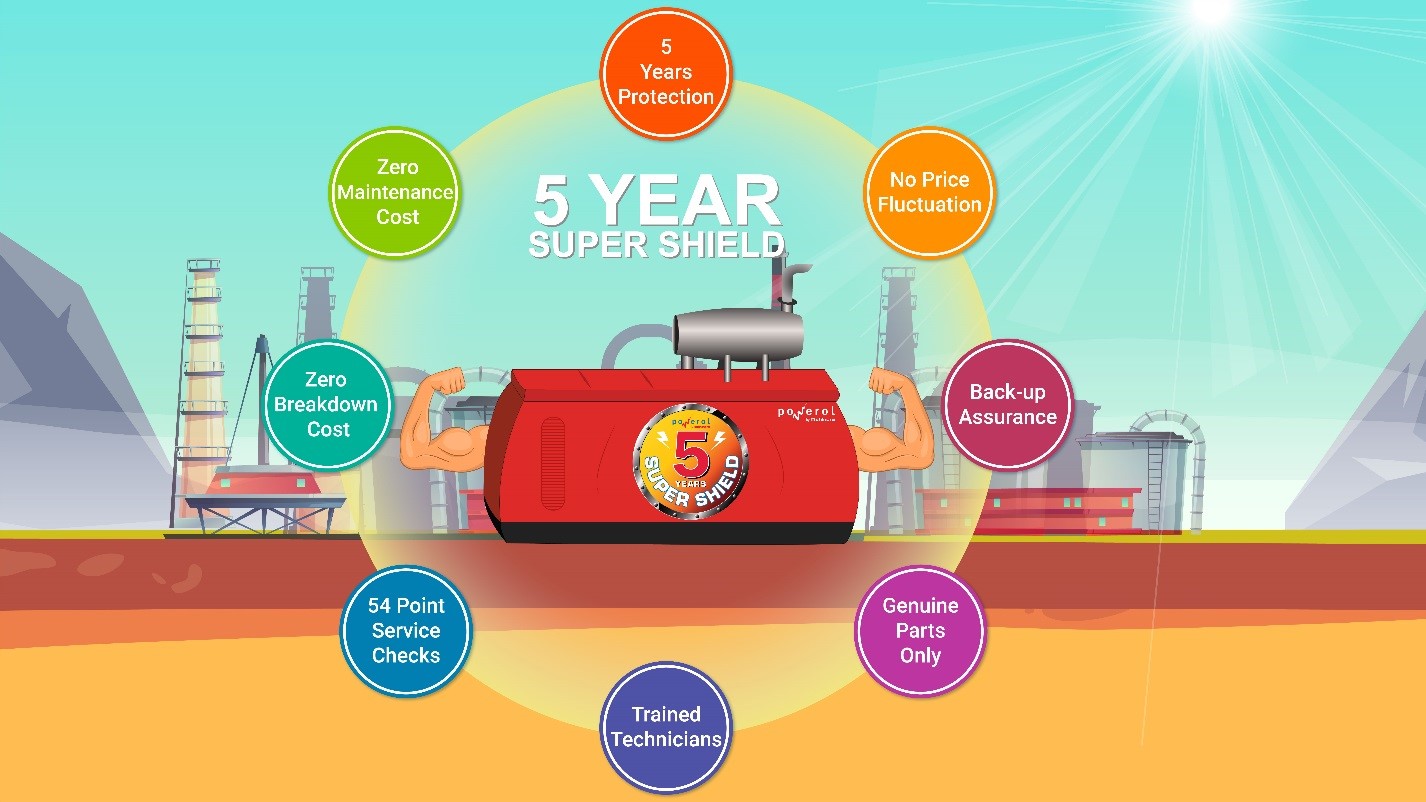
Mahindra Powerol brings a path breaking, first of its kind in the industry, service package SUPER SHIELD. A complete PEACE OF MIND for 5 years. What we are offering is not a 5 year extended warranty, it is much more than that. This is an offer which can only be executed when a brand has enough confidence in their product and services.


Mahindra Powerol welcomes you to the world of SUPER SHIELD.


Benefits of the SUPER SHIELD package at a glance:
  •      Manufacturer-backed complete protection to your Generator for 5 years or 6000 hours.
  •      Fixed operating cost and least cost of ownership.
  •      No additional cost for preventive maintenance services (including parts and labour).
  •      Protection from price fluctuation for 5 years.
  •      No additional cost of repair in the unlikely event of a breakdown.
  •      Assurance of a back-up Generator if a break down takes more than 48 hours to repair.
  •     54 point service checks during preventive maintenance every 3 months.
  •     Service by company trained technicians using genuine parts only.
  •     Available for Generator ratings of 82.5, 100, 125, 160, 180, 200, 250 & 320 KVA. 


SUPER SHIELD is a very robust yet simple offer, it takes care of everything. The customers only need to take care of the diesel filling. We will maintain the Battery for 2 years for zero additional cost after that customer needs to pay for the repair and replacement of the Battery.

Purchasing Generator is a long term investment. A smaller one-time investment in SUPER SHIELD protects your investment and gives you a complete PEACE OF MIND!!!

To know more about our products visit us at www.mahindrapowerol.com  or call us at 1800-419-1999 

Thursday, 13 February 2020

Use tap water in Radiator?


Water is an excellent medium for heat transfer. Then why not use plain tap water in the cooling system of the diesel engines instead of the branded Coolants available in the market?

Although water is one of the best mediums for heat transfer, it has got some limitations.

Water will start boiling as soon as the temperature reaches 100oC and will evaporate in the form of steam.
To increase the boiling temperature of water the cooling system is designed as a closed-loop system equipped with a Pressure Cap in the Radiator. The concept is similar to that of a Pressure Cooker. By chance, if there is a leak in the Pressure Cap of the Radiator, the water will evaporate at 100oC, if not refilled in time all the water will vanish and the engine will seize due to high temperature.


Water freezes at 0oC, it will not work in sub-zero ambient temperatures. The water will freeze and block the coolant passages and will also damage the Water Pump.

Water is corrosive when it comes in contact with ferrous metals. It will form rusts throughout the coolant flow paths and eventually choke it. At very high temperature water also corrodes aluminium and copper parts.

The minerals and other impurities present in water also contribute to scale formation along the paths of coolant flow. The fine water tubes of the radiator will get choked severely.


Rust and scale formation completely destroys the cooling efficiency and finally the engine will seize due to lack of cooling. Only a costly and time-consuming engine overhaul service can restore the engine in such cases.

That is why specially formulated Coolants are used in engine cooling systems. Various chemicals are added into the water to make the coolant which is most suitable for the engine.


COOLANT = Water + Anti Freezing Chemicals + Anti Boiling Chemicals + Rust Inhibitor Chemicals


Some brands will sell their coolants as Ready-To-Use (RTU). The benefit of using RTU Coolant is that you don’t have to mix it with water. You simply open the can and pour the coolant directly into the Radiator.


Do not mix different brands of coolant. Before adding the manufacturer recommended coolant flush out the old coolant (if it is of a different brand).


Some brands will sell concentrated or semi-concentrated coolants. In such cases, the user needs to mix the coolant with locally sourced water.

While mixing the concentrated or semi-concentrated coolant with water be careful with the quality of water you choose. Do not use tap water or well water. Water from these sources contains various metals, salts and other impurities and will completely defeat the purpose of your investment in branded Coolants.

Use only DM (Demineralized) water for mixing with Concentrated or Semi-Concentrated Coolants. DM water is not distilled water, it is specially purified water that has had most, or all of its mineral and salt ions removed. It is also known as Deionised water.


All water sources contain various minerals that can eat through aluminium or copper fins of the Radiator. Well water is typically full of iron and very hard. If that well water is softened, still it will contain sodium or salt. Tap water from the local municipal supply will have various amounts of Calcium, Fluoride and Chlorine. These will contribute to Scale formation or leakage.

Only in case of extreme urgency, use water as a coolant. But get the coolant as soon as possible and drain the water completely and refill with coolant as early as possible.

To know more about our products visit us at www.mahindrapowerol.com  or call us at 1800-419-1999  

Sunday, 19 January 2020

SMART CUSTOMER: Diesel Generator standard performance and deration

Did you ever face a situation where you bought a diesel generator and found that it is not giving the output as claimed in the marketing collateral's or presented during the sales pitch? Nothing can be more frustrating than that.

Probably this issue is related to deration, and we all must know about it.


When a generator operates in less than its rated capacity, it could possibly be that the generator is running with deration.


All diesel generators are designed to run efficiently at sea level under a standard condition of ambient Temperature and Pressure (STP). Generators are certified by the manufacturer which specifies the rating, and this rating is true at STP. Any fluctuation from STP can affect the performance of the generators. However, the effects of these factors are minimal unless the conditions are extreme.

            All generators need adequate air for combustion. Air is trapped inside the combustion chamber and is put through extremely high pressure and temperature combined with fuel. The mixture then ignites and pushes the piston down. The quality of air thus becomes very important to determine the power output from the ignition.

                In areas of high altitude, air pressure drops reducing the air density. This results in presence of less oxygen in the combustion chamber and hence reduces the power output. A lot of heat is generated during the combustion process. This heat needs to be dissipated, to maintain the optimum temperature for the engine. At high altitude, due to low air density heat dissipation happens at a lower rate and the engine remains hot and overheating could be a common problem.

                High ambient temperatures also reduce air density and can cause similar ignition 
problems due to inadequate air supply inside the combination chamber.

                In cases of extreme humidity, water vapour in the air displaces oxygen and low oxygen levels result in poor ignition.

We have tried to explain how non-standard ambient conditions can adversely affect generator performance. To guess the new output under the non-standard conditions, every manufacturer uses their own deration recommendation.

To know more about our products visit us at www.mahindrapowerol.com or call us at 1800-419-1999  


Friday, 17 January 2020

SMART CONSUMER – Natural Gas and its future in India


India has a heavy appetite for energy, we are the third largest energy consumer in the world today and will become top consumer within a decade. Our share of total global primary energy demand is set to double (to 11%) by 2040. Improving living standards and aspiring middle class of the country are driving this growing demand.

To meet this increasing energy demand India is strategically moving towards a gas-based economy. India aims to increase the share of gas from the current 6.2% to 15% in its primary energy mix by 2030. As per BP Energy Outlook, 2019, the gas consumption of India in 2040 is estimated to be 185 billion cubic meters.

In order to move towards 15% share of Natural Gas in our economy, various steps are being taken including enhancing natural gas production and building gas infrastructure (gas pipelines, City Gas Distribution networks and LNG regasification terminals).

Construction of over 16,800 km of pipeline is already completed and an additional 14,300 km to be done to complete the National Gas Grid, out of this 11,000 km is under construction now.

Petroleum & Natural Gas Regulatory Board (PNGRB) has authorized 228 geographic areas covering 406 districts spread over 27 States for City Gas Distribution (for both domestic and commercial use). The network will cater to 70% of the population in India.


Snapshot of City Gas Distribution (CGD) authorization in India


A brief of major gas pipeline projects which are being implemented by Central Government PSUs are as under
(Source: http://petroleum.nic.in/natural-gas/about-natural-gas)

Jagdishpur – Haldia/Bokaro – Dhamra Pipeline Project (JHBDPL) & Barauni- Guwahati Pipeline project (BGPL):
GAIL is executing a 2655 km. long pipeline project. Phase-I of the project from Phulpur up to Dobhi (Gaya) with spur line to Varanasi, Patna, Gorakhpur & Barauni has been commissioned in 2019. Further, Pipeline from Barauni to Guwahati is also being implemented as an integral part JHBDPL project to connect North East Region (NER) with the National Gas Grid. The approx. length of the pipeline is 729 km. The entire project will cater to the energy demand of Eastern and North-Eastern Region covering six states, namely Uttar Pradesh, Bihar, Jharkhand, Odisha, West Bengal and Assam.

North East Region (NER) Gas Grid:
A joint venture of five oil and gas CPSE's i.e. GAIL, IOCL, OIL, ONGC and NRL named as “Indradhanush Gas Grid Ltd” (IGGL) has been entrusted to develop trunk pipeline connectivity in all North Eastern States i.e. Assam, Sikkim, Mizoram, Manipur, Aruncahal Pradesh, Tripura, Nagaland and Meghalaya in a phased manner. Prime objective of these pipelines would be to transport the domestic natural gas produced in the north east states and the same may first cater to the local requirements. It shall also connect the NER grid to the National Gas Grid.

Kochi-Koottanad- Bangalore-Mangalore (Ph-II) Pipeline Project (KKBMPL):
41 Km of Phase-I of pipeline has been commissioned and 887 Km of Phase-II is under progress in two sections. Construction work by GAIL of Kochi-Koottanad- Mangalore Section (444 Kms) is under progress and expected to be commissioned shortly. Work on other section is under progress.

Ennore-Thiruvallur-Bangalore-Nagapattinum– Madurai – Tuticorin Natural gas pipeline (ETBNMTPL):
IOCL is laying Ennore-Thiruvallur-Bangalore-Nagapattinum– Madurai – Tuticorin Natural gas pipeline (ETBNMTPL), length- 1385 km. This pipeline will connect new Ennore LNG Terminal with various demand centers in the region.


What is Natural Gas?

Dead organisms buried under sedimentary rock for millions of years, subjected to intense heat and pressure, gets converted to crude oil (petroleum) and natural gas.

Natural Gas is the cleanest of all fossil fuels. When burned it produces fewer greenhouse gases and air pollutants when compared to other fossil fuels. Natural Gas is primarily Methane (CH4) with smaller quantities of other hydrocarbons (Ethane – C2H6, Propane – C3H8, Butane – C4H10 etc).


After extraction, the gas is sent to a processing plant to separate the impurities from the pure gas. After processing it is transported to distribution center through pipelines. From the distribution centers the gas is supplied for various industrial and domestic use.


With recent improvements in the oil and gas extraction technology and better infrastructure the usage of natural gas is poised for an exponential growth. It is increasingly becoming a popular choice of fuel for locomotives and power generation.

Let us understand the various types of gases available in the market today.

PNG (Piped Natural Gas):
It is the Natural Gas which is distributed to individual users through pipe lines. PNG is safer than LPG, being lighter than air it dissipates quickly in the air in case of a leakage. As PNG is supplied through pipes, there is no need to store the gas in cylinders, it is an uninterrupted supply. 


CNG (Compressed Natural Gas):
It is the Natural Gas in compressed form. They are stored in cylinders and commonly used in vehicles.


LPG (Liquefied Petroleum Gas):

It is not the Natural Gas. It is a by-product of Petroleum. Derived during refining of the Petroleum. Contains primarily Propane and Butane and other compounds. They are stored in cylinders and commonly used as cooking gas. It is heavier than air.


LNG (Liquid Natural Gas):
Natural Gas becomes liquid in extreme low temperature (-162oC) and the volume reduces 620 times. The liquid is stored in vessels and transported to various parts of the world. When LNG reaches its destination, it is again converted to gas in regasification facilities.


Be a part of India’s gas revolution.

To know more about our products visit us at www.mahindrapowerol.com or call us at 1800-419-1999